
Amongst some of the odder things I have looked after in my life included a herd of Pedigree Anglo-Nubian Dairy goats.
Goats belong to one of those less kept animal groups in the UK, though of course they are a way of life in some less developed countries. In the UK, goat ownership enjoyed a brief surge of popularity in the post-war years. Herd books swelled and goat showing of prime animals had large classes at agricultural shows, but popularity started to really wane from the turn of the Millennium.
We initially started to keep them on the smallholding for milk production. Like cows, though, goats need to produce offspring to produce milk, and it wasn’t long before we were dealing with several gallons of milk each day and looking after 20+ animals.
The upsides to ownership are:
- They graze the land.
- They are highly productive.
- They are relatively small to handle.
The downsides are:
- They need their feet regularly trimmed (which you do yourself).
- They have to be moved under specific documentation.
- They ought to have regular blood tests and vaccinations.
- They need good feed, hay, and clean sheds with straw.
- The ultimate service of the knacker man is not cheap.
However, what they produce is wonderful. What many people don’t realise is that goats’ products—the milk, cream, cheese, and meat—should not give any hint of an origin of “goat” if it is hygienically produced from animals that have not been fed too many brassicas. Goats’ products are clear in taste and white in colour—they process chlorophyll better than cows, meaning their products are bright white unless artificially coloured with annatto. The meat is leaner than lamb, and I have never tasted better offal.
In time, I got an electric cream separator—a wonderful gizmo full of cones which worked on centrifugal principles and could split skimmed milk from the cream. Oh, the cream! You could put it in a fridge straight from the separator and, by the morning, stand a teaspoon upright in the dish with no beating required. It’s clean-tasting, bright white, uncloying cream, quite exquisite with sharp fruit. It made superb ice cream, especially when the custard base was made from goats’ milk and eggs from our own hens.
We made soft cheeses, sold loads of milk to feed puppies (it’s better for dogs than cow’s milk), and supplied lots of excess colostrum for feeding baby hedgehogs! Then we would raise the excess, usually male castrated kids, for about 10 months and take them to the local slaughterhouse as close in time to dropping them as possible. We were able to eat meat that we knew had been raised with care and respect. This process had the added advantage that my children grew up well aware of what it took to eat meat.
I also raised my children on goats’ milk from the earliest months of their lives. I couldn’t stand to read the artificial ingredients list on a tin of formula. In my book, goats’ milk was natural, rich, creamy, and had to be far better than a tin of artificial milk product. So that’s what my kids were raised on. My research did determine that there may have been a slight vitamin deficiency, but I just added a small mix of four vitamins made for babies, and that’s what I raised my children on. They both grew up as healthy children, and I am sure it did them no harm.
I probably kept the goats for about 10 years. In time, they became too time-consuming to maintain, but I could still wish to go out and find a leg of chevon in the freezer
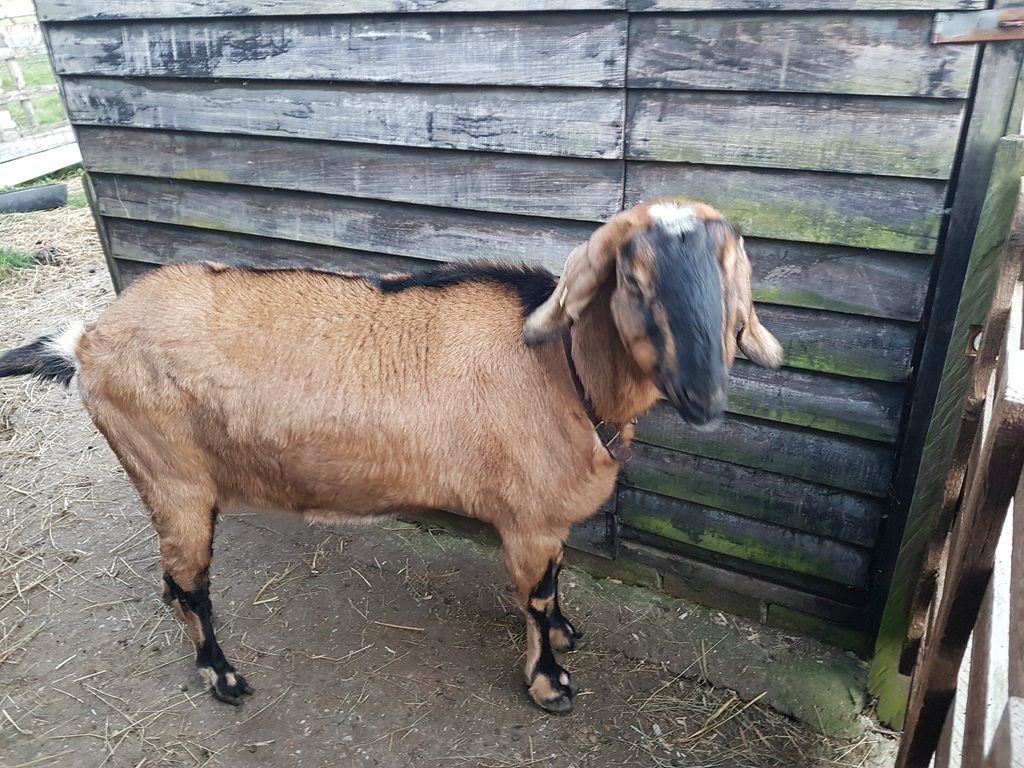
Above: the last girl of the era!